
DenseArgvals#
- class FDApy.representation.DenseArgvals(dict=None, /, **kwargs)[source]#
Represent the argvals of dense functional data.
This class extends the Argvals class to represent a dictionary where the keys are strings and the values are np.ndarray. It provides additional functionality for working with argument values in scientific computing.
- Attributes:
n_points (Tuple[int, …]) – Number of sampling points of each dimension.
n_dimension (int) – Number of input dimension of the data.
min_max (Dict[str, Tuple[float, float]]) – Minimum and maximum sampling points for each dimension.
Methods
clear()compatible_with(values)Raise an error if Argvals is not compatible with Values.
concatenate(*argvals)Concatenate DenseArgvals objects.
copy()fromkeys(iterable[, value])get(k[,d])items()keys()Normalize the DenseArgvals.
pop(k[,d])If key is not found, d is returned if given, otherwise KeyError is raised.
popitem()as a 2-tuple; but raise KeyError if D is empty.
range([percentage])Get the range of sampling points for each dimension.
setdefault(k[,d])update([E, ]**F)If E present and has a .keys() method, does: for k in E: D[k] = E[k] If E present and lacks .keys() method, does: for (k, v) in E: D[k] = v In either case, this is followed by: for k, v in F.items(): D[k] = v
values()- clear() None. Remove all items from D.#
- compatible_with(values)[source]#
Raise an error if Argvals is not compatible with Values.
- Parameters:
values (Type[Values]) – A Values object.
- Raises:
ValueError – When self and values do not have coherent common sampling points. The first dimension of values is assumed to represented the number of observations.
- Return type:
None
- static concatenate(*argvals)[source]#
Concatenate DenseArgvals objects.
It does not make sense to concatenate DenseArgvals. This function checks that all the DenseArgvals objects pass as arguments are the same and return the first one. It raises an error if one is different.
- Parameters:
argvals – The DenseArgvals objects to concatenate.
- Returns:
The first elements of the input list.
- Return type:
- Raises:
ValueError – When all argvals are not equal.
- copy()#
- classmethod fromkeys(iterable, value=None)#
- get(k[, d]) D[k] if k in D, else d. d defaults to None.#
- items() a set-like object providing a view on D's items#
- keys() a set-like object providing a view on D's keys#
- normalization()[source]#
Normalize the DenseArgvals.
This function normalizes the Argvals by applying the following transformation to each dimension of the Argvals:
\[X_{norm} = \frac{X - \min{X}}{\max{X} - \min{X}}.\]- Returns:
Normalized argvals.
- Return type:
- pop(k[, d]) v, remove specified key and return the corresponding value.#
If key is not found, d is returned if given, otherwise KeyError is raised.
- popitem() (k, v), remove and return some (key, value) pair#
as a 2-tuple; but raise KeyError if D is empty.
- setdefault(k[, d]) D.get(k,d), also set D[k]=d if k not in D#
- update([E, ]**F) None. Update D from mapping/iterable E and F.#
If E present and has a .keys() method, does: for k in E: D[k] = E[k] If E present and lacks .keys() method, does: for (k, v) in E: D[k] = v In either case, this is followed by: for k, v in F.items(): D[k] = v
- values() an object providing a view on D's values#
Examples using FDApy.representation.DenseArgvals#

Representation of univariate and dense functional data

Representation of univariate and irregular functional data


Smoothing of dense one-dimensional functional data

Smoothing of dense two-dimensional functional data
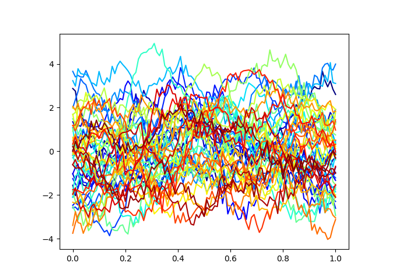


Simulation using multivariate Karhunen-Loève decomposition

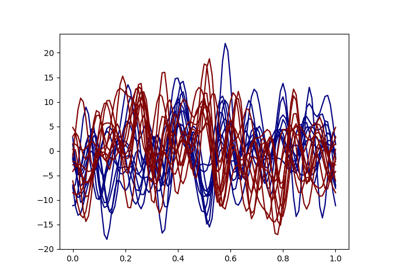
Simulation of clusters of univariate functional data

Simulation of clusters of multivariate functional data