
Argvals#
- class FDApy.representation.Argvals(dict=None, /, **kwargs)[source]#
Define the structure of Argvals.
- Attributes:
n_points (Tuple[int, …] | Dict[int, Tuple[int, …]]) – Number of sampling points of each dimension.
n_dimension (int) – Number of input dimension of the data.
min_max (Dict[str, Tuple[float, float]]) – Minimum and maximum sampling points for each dimension.
Methods
clear()compatible_with(values)Raise an error if Argvals is not compatible with Values.
concatenate(*argvals)Concatenate Argvals objects.
copy()fromkeys(iterable[, value])get(k[,d])items()keys()Normalize the Argvals.
pop(k[,d])If key is not found, d is returned if given, otherwise KeyError is raised.
popitem()as a 2-tuple; but raise KeyError if D is empty.
setdefault(k[,d])update([E, ]**F)If E present and has a .keys() method, does: for k in E: D[k] = E[k] If E present and lacks .keys() method, does: for (k, v) in E: D[k] = v In either case, this is followed by: for k, v in F.items(): D[k] = v
values()- clear() None. Remove all items from D.#
- compatible_with(values)[source]#
Raise an error if Argvals is not compatible with Values.
- Parameters:
values (Type[Values]) – A Values object.
- Raises:
ValueError – When self and values do not have coherent common sampling points. The first dimension of values is assumed to represented the number of observations.
- Return type:
None
- copy()#
- classmethod fromkeys(iterable, value=None)#
- get(k[, d]) D[k] if k in D, else d. d defaults to None.#
- items() a set-like object providing a view on D's items#
- keys() a set-like object providing a view on D's keys#
- pop(k[, d]) v, remove specified key and return the corresponding value.#
If key is not found, d is returned if given, otherwise KeyError is raised.
- popitem() (k, v), remove and return some (key, value) pair#
as a 2-tuple; but raise KeyError if D is empty.
- setdefault(k[, d]) D.get(k,d), also set D[k]=d if k not in D#
- update([E, ]**F) None. Update D from mapping/iterable E and F.#
If E present and has a .keys() method, does: for k in E: D[k] = E[k] If E present and lacks .keys() method, does: for (k, v) in E: D[k] = v In either case, this is followed by: for k, v in F.items(): D[k] = v
- values() an object providing a view on D's values#
Examples using FDApy.representation.Argvals#

Representation of univariate and dense functional data

Representation of univariate and irregular functional data


Smoothing of dense one-dimensional functional data

Smoothing of dense two-dimensional functional data
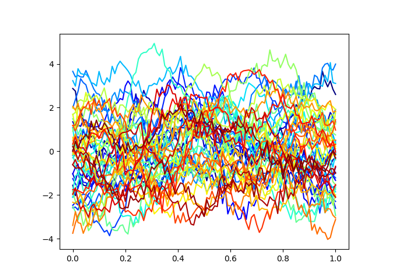


Simulation using multivariate Karhunen-Loève decomposition

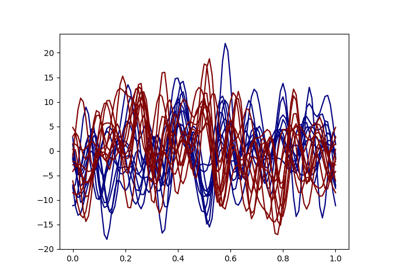
Simulation of clusters of univariate functional data

Simulation of clusters of multivariate functional data