Note
Go to the end to download the full example code.
Canadian weather dataset#
Example of the Canadian weather dataset.
# Author: Steven Golovkine <steven_golovkine@icloud.com>
# License: MIT

# Load packages
import matplotlib.pyplot as plt
import numpy as np

from FDApy.representation import DenseArgvals
from FDApy.preprocessing import UFPCA

from FDApy import read_csv
from FDApy.visualization import plot

# Load data
temp_data = read_csv("../data/canadian_temperature_daily.csv", index_col=0)


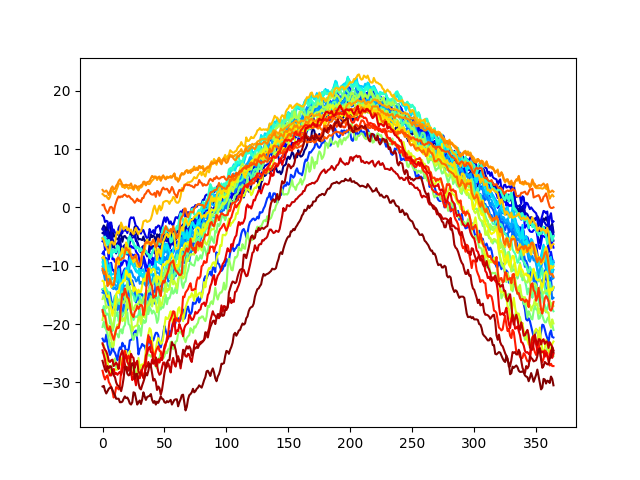
_ = plot(temp_data)
Smooth the data
points = DenseArgvals({"input_dim_0": np.linspace(1, 365, 365)})
kernel_name = "epanechnikov"
bandwidth = 30
degree = 1

temp_smooth = temp_data.smooth(
    points=points,
    method="LP",
    kernel_name=kernel_name,
    bandwidth=bandwidth,
    degree=degree,
)


fig, axes = plt.subplots(2, 2, figsize=(10, 8))
for idx, ax in enumerate(axes.flat):
    plot(temp_data[idx], colors="k", alpha=0.2, ax=ax)
    plot(temp_smooth[idx], colors="r", ax=ax)
    ax.set_title(f"Observation {idx + 1}")
plt.show()

Perform UFPCA
ufpca = UFPCA(n_components=0.99, method="inner-product")
ufpca.fit(temp_smooth)

# Plot the eigenfunctions
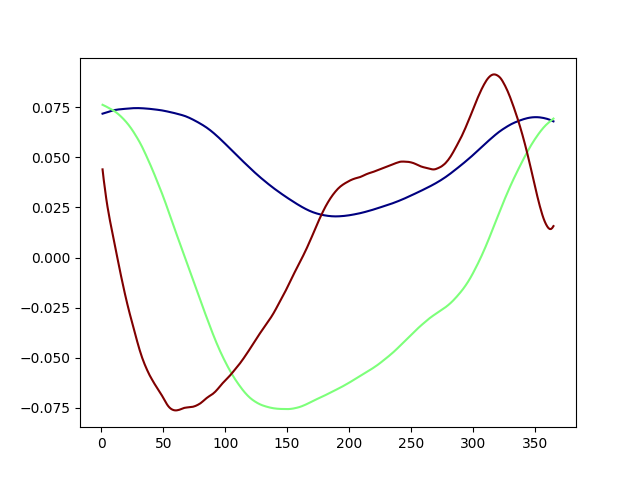
_ = plot(ufpca.eigenfunctions)
Compute the scores
scores = ufpca.transform(method="InnPro")

# Plot of the scores
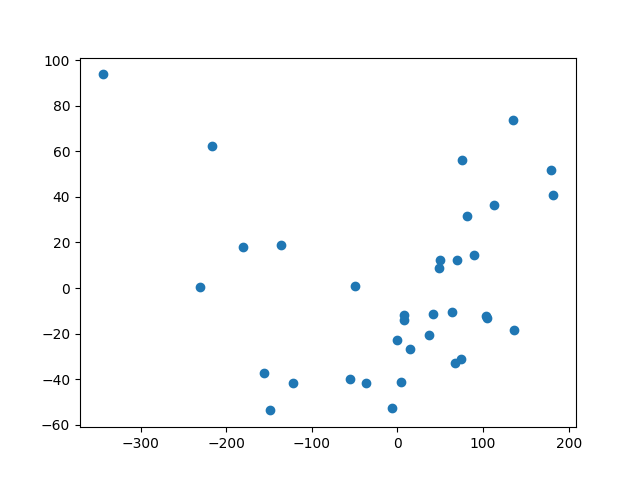
_ = plt.scatter(scores[:, 0], scores[:, 1])
Reconstruction of the curves
data_recons = ufpca.inverse_transform(scores)
Plot of the reconstruction
fig, axes = plt.subplots(nrows=5, ncols=2, figsize=(16, 16))
for idx_plot, idx in enumerate(np.random.choice(temp_data.n_obs, 10)):
    temp_ax = axes.flatten()[idx_plot]
    temp_ax = plot(temp_data[idx], colors="k", alpha=0.2, ax=temp_ax, label="Data")
    plot(temp_smooth[idx], colors="r", ax=temp_ax, label="Smooth")
    plot(data_recons[idx], colors="b", ax=temp_ax, label="Reconstruction")
    temp_ax.legend()
plt.show()

Total running time of the script: (0 minutes 2.470 seconds)